
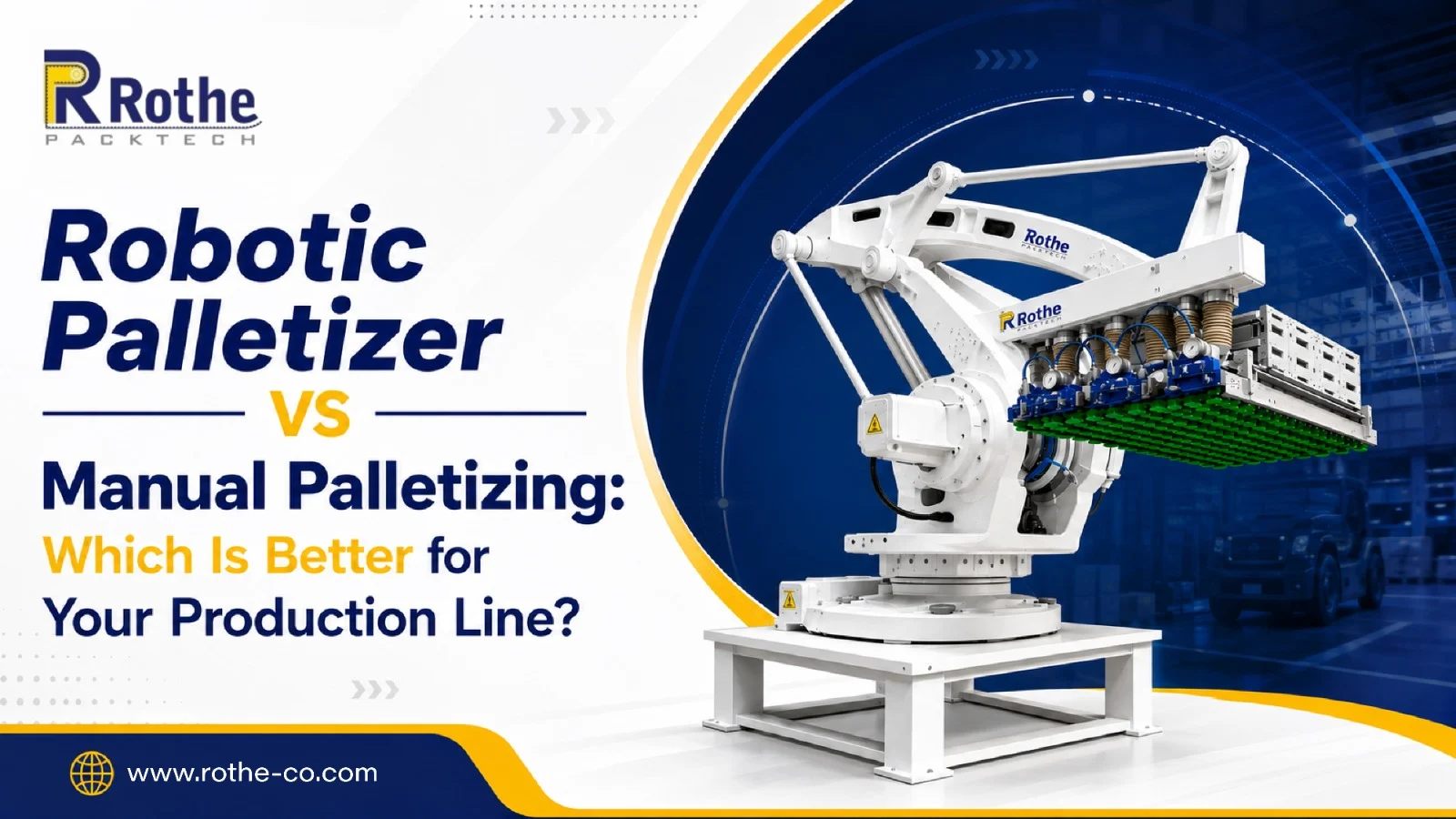
Palletizing is one of the most repetitive activities at the end of a manufacturing and packaging line. For years, manufacturers have depended on operators to manually lift, arrange, and stack cartons, bags, boxes, and other finished products onto pallets.
But as production volumes increase and manufacturers face pressure to improve productivity, reduce manual handling, and maintain consistent output, many companies are considering automation.
This raises an important question:
Should you continue with manual palletizing or invest in a robotic palletizer?
The right choice depends on your production volume, product characteristics, labour requirements, available space, and long-term growth plans. However, for many medium- and high-volume manufacturing operations, robotic palletizing can offer significant advantages.
What Is a Robotic Palletizer?
A robotic palletizer is an automated robotic system designed to pick products or cases and arrange them onto pallets according to a predefined stacking pattern.
A typical robotic palletizing cell may include:
- Industrial robot
- End-of-arm tooling
- Conveyor system
- Pallet dispenser
- Pallet conveyor
- Safety fencing and sensors
- Product detection systems
- Control panel and PLC
- Pallet pattern programming
The system can be integrated directly with an existing packaging line or designed as part of a complete end-of-line automation solution.
Manual Palletizing vs Robotic Palletizing
The biggest difference is the level of human involvement.
In manual palletizing, operators physically handle and stack products. In robotic palletizing, the robot performs the repetitive handling and stacking operation while operators supervise the system and manage other production activities.
Factor | Manual Palletizing | Robotic Palletizing |
Labour requirement | High | Lower |
Repetitive handling | Performed manually | Automated |
Stacking consistency | Operator-dependent | Highly repeatable |
Production speed | Dependent on operators | Consistent programmed speed |
Workplace ergonomics | Higher physical workload | Reduced manual lifting |
Scalability | Requires additional manpower | Can support increased production |
Pattern flexibility | Manual adjustment | Programmable |
Data and controls | Limited | Automated controls and monitoring |
Long-term productivity | Labour dependent | Automation driven |
1. Productivity: How Much Can You Produce?
Production speed is one of the most important considerations when evaluating palletizing automation.
Manual palletizing speed depends on the number of operators, product weight, pallet pattern, shift duration, fatigue, and production conditions.
A robotic palletizer operates according to a programmed sequence and can maintain consistent movements throughout the production cycle.
For manufacturers running multiple shifts or high-volume production lines, this consistency can become particularly valuable.
If your packaging line is faster than your palletizing operation, palletizing can become a production bottleneck.
Automation can help synchronize palletizing with the rest of the end-of-line process.
2. Labour Dependency
Manual palletizing requires operators to repeatedly lift, move, position, and stack products.
As production increases, manufacturers may need additional manpower or shift resources to maintain output.
A robotic palletizer reduces the requirement for repetitive manual handling and allows operators to focus on activities such as:
- Production monitoring
- Quality inspection
- Machine supervision
- Material replenishment
- Process control
- Maintenance support
This does not necessarily mean eliminating employees. Instead, automation can help manufacturers use their workforce more effectively.
3. Consistent Pallet Patterns
Pallet stability is important for storage and transportation.
Manual stacking can sometimes result in inconsistent positioning, especially when operators are working for extended periods or handling multiple SKUs.
A robotic palletizer can be programmed to follow a specific pallet pattern repeatedly.
This can help provide:
- Consistent stacking
- Better pallet stability
- Improved space utilization
- Repeatable product positioning
- Better dispatch presentation
For manufacturers shipping large quantities of products every day, consistency can have a significant operational impact.
4. Workplace Safety and Ergonomics
Repeated lifting and stacking can place physical stress on workers, particularly when products are heavy or palletizing takes place continuously across multiple shifts.
Robotic palletizing can reduce repetitive lifting and manual product movement.
The robot handles the repetitive physical task while operators supervise and manage the overall process.
This can contribute to a safer and more ergonomically efficient production environment.
5. Flexibility for Multiple Products
Modern manufacturing lines often handle multiple products, packaging formats, and SKUs.
A robotic palletizer can be programmed for different pallet patterns and product configurations.
With suitable tooling and programming, the same robotic system can potentially handle different:
- Carton sizes
- Product weights
- Pallet dimensions
- Stacking patterns
- Production SKUs
This flexibility makes robotic palletizing particularly useful for manufacturers looking to scale product variety without completely redesigning their end-of-line operation.
6. Floor Space and Line Integration
A robotic palletizing system can be engineered according to the available plant layout.
The robot, conveyors, pallet handling equipment, safety systems, and product flow can be integrated into a coordinated cell.
For plants with limited floor space, engineering the complete cell around the existing production line becomes especially important.
The objective is not simply to install a robot.
The objective is to create an efficient palletizing process.
When Should You Consider a Robotic Palletizer?
Robotic palletizing may be worth considering if your production line has one or more of the following challenges:
High Production Volumes
If your line produces a large number of cases or products continuously, manual palletizing can become difficult to sustain.
Multiple Production Shifts
When production operates across multiple shifts, reducing dependence on repetitive manual handling can become increasingly valuable.
Labour Availability Challenges
Difficulty recruiting or retaining workers for repetitive palletizing operations can encourage manufacturers to explore automation.
Heavy or Difficult-to-Handle Products
Products that require repeated lifting or awkward handling can be strong candidates for robotic palletizing.
Frequent Quality Issues
If inconsistent stacking or pallet patterns are affecting product handling or transportation, automated palletizing can improve repeatability.
Future Production Expansion
If you expect production volumes to increase, investing in automation can help prepare the end-of-line process for future requirements.
Is Manual Palletizing Still the Right Choice?
Yes.
Robotic automation is not automatically the best solution for every manufacturing line.
Manual palletizing can still make sense when:
- Production volumes are relatively low
- Product changes are extremely frequent
- Investment budgets are limited
- Palletizing is only an occasional operation
- The product is lightweight and easy to handle
- The production line does not justify automation yet
The decision should therefore be based on the total operating requirements rather than simply comparing the purchase price of a robot with the cost of manual labour.
The ROI of a Robotic Palletizer
The business case for robotic palletizing should consider more than initial equipment cost.
Manufacturers should evaluate:
Labour + productivity + downtime + product handling + safety + quality + future scalability
A robotic palletizer can provide value through:
- Reduced repetitive manual handling
- Consistent production output
- Improved palletizing quality
- Reduced operational dependency on manual labour
- Better production scalability
- Improved end-of-line efficiency
The actual return on investment will depend on production volume, operating hours, product characteristics, labour costs, system configuration, and the level of automation required.
A technical assessment is therefore important before selecting the system.
Robotic Palletizer as Part of Complete End-of-Line Automation
A robotic palletizer delivers even greater value when it is integrated with the complete packaging line.
A typical automated flow can be:
Production → Packaging → Case Packing → Conveyor → Robotic Palletizing → Pallet Handling → Dispatch
This eliminates unnecessary manual transfer between individual stages and creates a more connected production flow.
For manufacturers planning broader automation, palletizing can therefore become an important first step toward complete end-of-line automation.
Why Choose a Customized Robotic Palletizing Solution?
Every production line has different requirements.
The ideal robotic palletizer depends on:
- Product dimensions
- Product weight
- Cases per minute
- Number of SKUs
- Pallet size
- Required pallet pattern
- Factory layout
- Conveyor configuration
- Changeover requirements
- Future production capacity
A customized automation approach allows the robotic cell to be designed around the actual production environment.
Ready to Automate Your Palletizing Process?
If manual palletizing is becoming a bottleneck for your production line, it may be time to evaluate automation.
Rothe Packtech provides engineered automation solutions for modern manufacturing environments, including robotic palletizing, case packing, conveyor integration, robotic pick-and-place systems, and complete end-of-line automation.
Instead of simply supplying a robot, the focus should be on developing a palletizing solution that integrates effectively with your production and packaging process.
Ready to Improve Your Production Efficiency?
Talk to Rothe Packtech’s automation experts to discuss your production line and explore the right end-of-line packaging automation solution for your application.