
Manufacturing efficiency doesn’t stop when the product leaves the production machine.
After production, products still need to be packed, transferred, arranged, palletized, and prepared for dispatch. When these activities depend heavily on manual labour, they can become bottlenecks that limit the efficiency of the entire production line.
This is where end-of-line automation can make a significant difference.
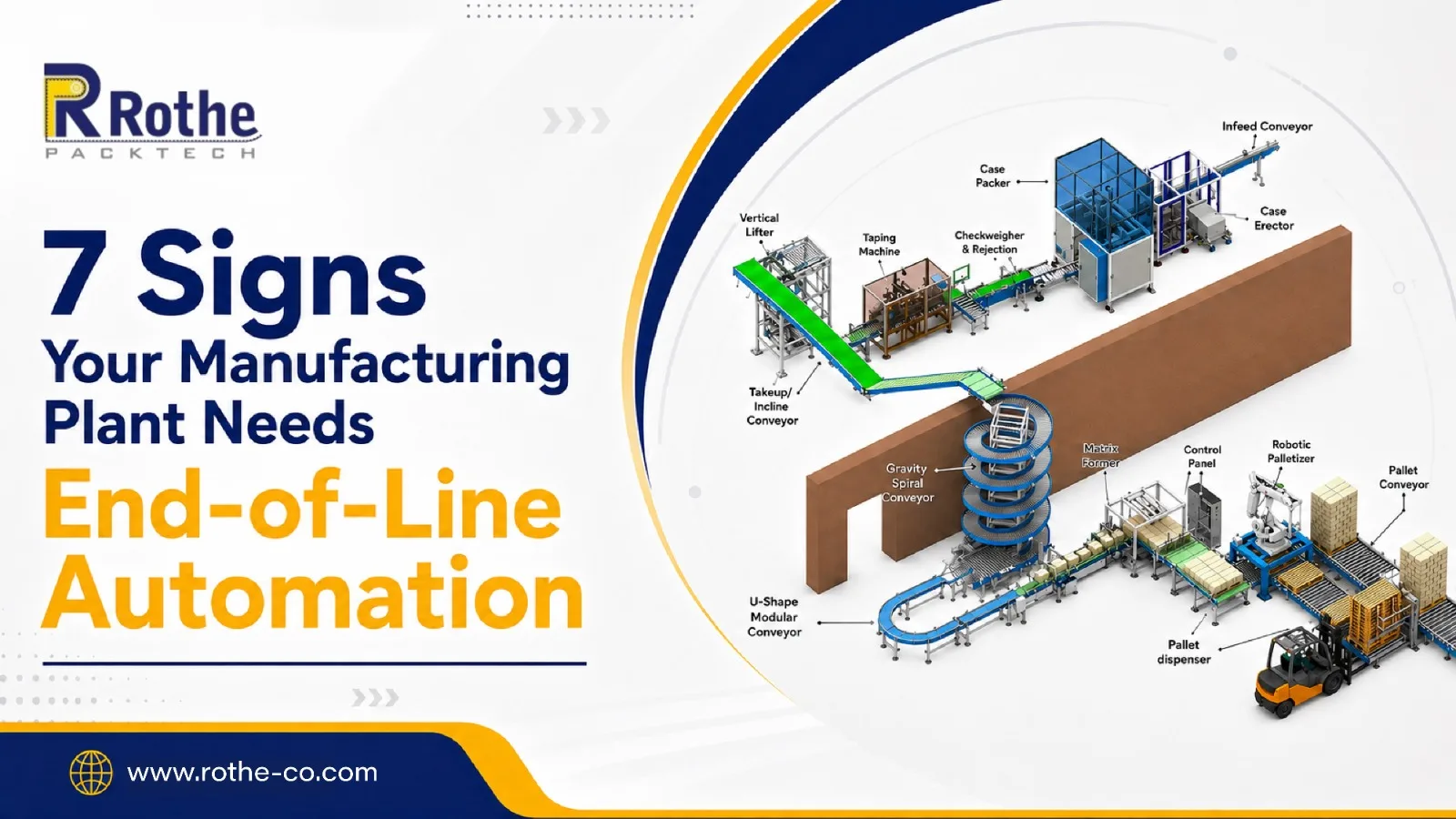
By integrating technologies such as case packers, conveyors, robotic pick-and-place systems, robotic palletizers, and automated material handling, manufacturers can transform repetitive end-of-line operations into a more consistent and scalable process.
But how do you know when your plant is ready for automation?
Here are 7 signs that your manufacturing operation may need end-of-line automation.
1. Your Production Line Is Faster Than Your Packaging Process
The Problem
Your production equipment is capable of producing products at a high rate, but products begin accumulating before packing, palletizing, or dispatch.
This creates an imbalance in the production line.
Even if your primary manufacturing equipment has available capacity, a slow manual packaging operation can prevent you from achieving the desired overall output.
The Solution: Connect Your End-of-Line Process
End-of-line automation can connect product handling, packing, conveying, and palletizing into a coordinated workflow.
For example:
Production → Case Packing → Conveyor → Robotic Palletizing → Dispatch
This helps downstream processes keep pace with production and reduces the possibility of packaging becoming the bottleneck.
2. You Depend Heavily on Manual Labour for Repetitive Tasks
The Problem
Operators spend significant portions of their shifts performing repetitive activities such as:
- Picking products
- Loading cartons
- Moving cases
- Arranging products
- Stacking pallets
- Transferring finished goods
As production volumes increase, additional manpower may be required to maintain the same output.
Labour availability can also become a challenge, particularly for repetitive and physically demanding jobs.
The Solution: Automate Repetitive Handling
Automation can take over repetitive operations while allowing employees to focus on supervision, quality control, machine operation, and other higher-value activities.
Case packers, conveyors, robotic pick-and-place systems, and robotic palletizers can significantly reduce manual intervention at the end of the production line.
3. Your Palletizing Process Is Becoming a Bottleneck
The Problem
Products are packed successfully, but operators are struggling to palletize them quickly enough.
Manual palletizing can become particularly challenging when products are heavy, production volumes are high, or the line operates for multiple shifts.
The result can be product accumulation, production interruptions, or increased manpower requirements.
The Solution: Robotic Palletizing
A robotic palletizer can automatically pick products or cases and arrange them on pallets according to a programmed pattern.
This provides consistent palletizing performance and can reduce repetitive manual lifting.
For high-volume operations, robotic palletizing can help create a more reliable connection between packaging and dispatch.
4. Your Packaging Quality Is Inconsistent
The Problem
Manual operations can introduce variations in:
- Product positioning
- Case loading
- Carton arrangement
- Pallet patterns
- Product handling
Even small inconsistencies can affect packaging appearance, pallet stability, storage, and transportation.
The Solution: Repeatable Automated Processes
Automated equipment performs programmed movements consistently.
A case packer can follow a predefined packing configuration, while a robotic palletizer can repeat the required pallet pattern.
This helps create greater consistency across production batches.
5. Your Operators Are Performing Physically Demanding Work
The Problem
Repeated lifting, carrying, bending, and stacking can place significant physical demands on workers.
This becomes more challenging when heavy cartons, bags, containers, or other products need to be handled continuously throughout a shift.
The Solution: Reduce Manual Handling
Automation can take over repetitive and physically demanding material-handling activities.
Conveyors can move products between processes, robotic systems can perform picking and positioning, and robotic palletizers can handle repetitive stacking.
The result is a production environment where operators can spend less time performing physically repetitive tasks.
6. Your Production Volume Is Growing
The Problem
Your business is expanding, but your end-of-line process has not changed.
You may be producing more products without having sufficient capacity in packing, conveying, or palletizing.
Simply adding more operators may solve the immediate problem, but it may not provide the scalability required for long-term growth.
The Solution: Build a Scalable Automated Line
End-of-line automation can provide a foundation for increasing production capacity.
Instead of continuously adding manpower as output grows, manufacturers can invest in automated processes designed around their current requirements and future production goals.
A scalable system can also be designed to accommodate additional SKUs, production shifts, or future equipment integration.
7. Your Production Line Has Too Many Manual Transfers
The Problem
Products move through multiple manual stages:
Machine → Operator → Packing → Operator → Pallet → Operator → Dispatch
Every manual transfer introduces additional handling, movement, and potential delays.
It can also make it difficult to maintain a smooth material flow across the plant.
The Solution: Integrate Your End-of-Line Operations
An integrated automation system can connect multiple processes using conveyors, robotic systems, and automated packaging equipment.
A more streamlined workflow could look like:
Production → Packing → Conveying → Palletizing → Pallet Handling → Dispatch
This reduces unnecessary manual transfers and creates a more connected end-of-line process.
Should You Automate Everything at Once?
Not necessarily.
Automation can be introduced progressively based on the biggest operational challenge.
For example:
Labour-intensive packing → Case Packer
Manual product transfer → Conveyor Automation
Repetitive product handling → Robotic Pick-and-Place
Manual palletizing → Robotic Palletizer
Multiple disconnected processes → Complete End-of-Line Automation
This allows manufacturers to prioritize the areas where automation can provide the greatest operational impact.
From Production Bottleneck to Automated Workflow
The goal of end-of-line automation is not simply to replace a manual operation with a machine.
The real objective is to improve the complete flow of products from manufacturing to dispatch.
When packing, conveying, robotic handling, palletizing, and material movement are properly integrated, manufacturers can build a more:
Efficient → Consistent → Scalable → Safe → Automated
production environment.
Turn Your End-of-Line Problems Into Automation Opportunities
If your manufacturing plant is experiencing labour dependency, packaging bottlenecks, inconsistent palletizing, repetitive manual handling, or growing production volumes, it may be time to evaluate end-of-line automation.
Rothe Packtech provides engineered automation solutions including case packing, robotic pick-and-place, conveyor integration, robotic palletizing, and complete end-of-line automation.
The solution can be designed around your products, production requirements, packaging configuration, plant layout, and future expansion plans.
Ready to Improve Your Production Efficiency?
Talk to Rothe Packtech’s automation experts to discuss your production line and explore the right end-of-line packaging automation solution for your application.