
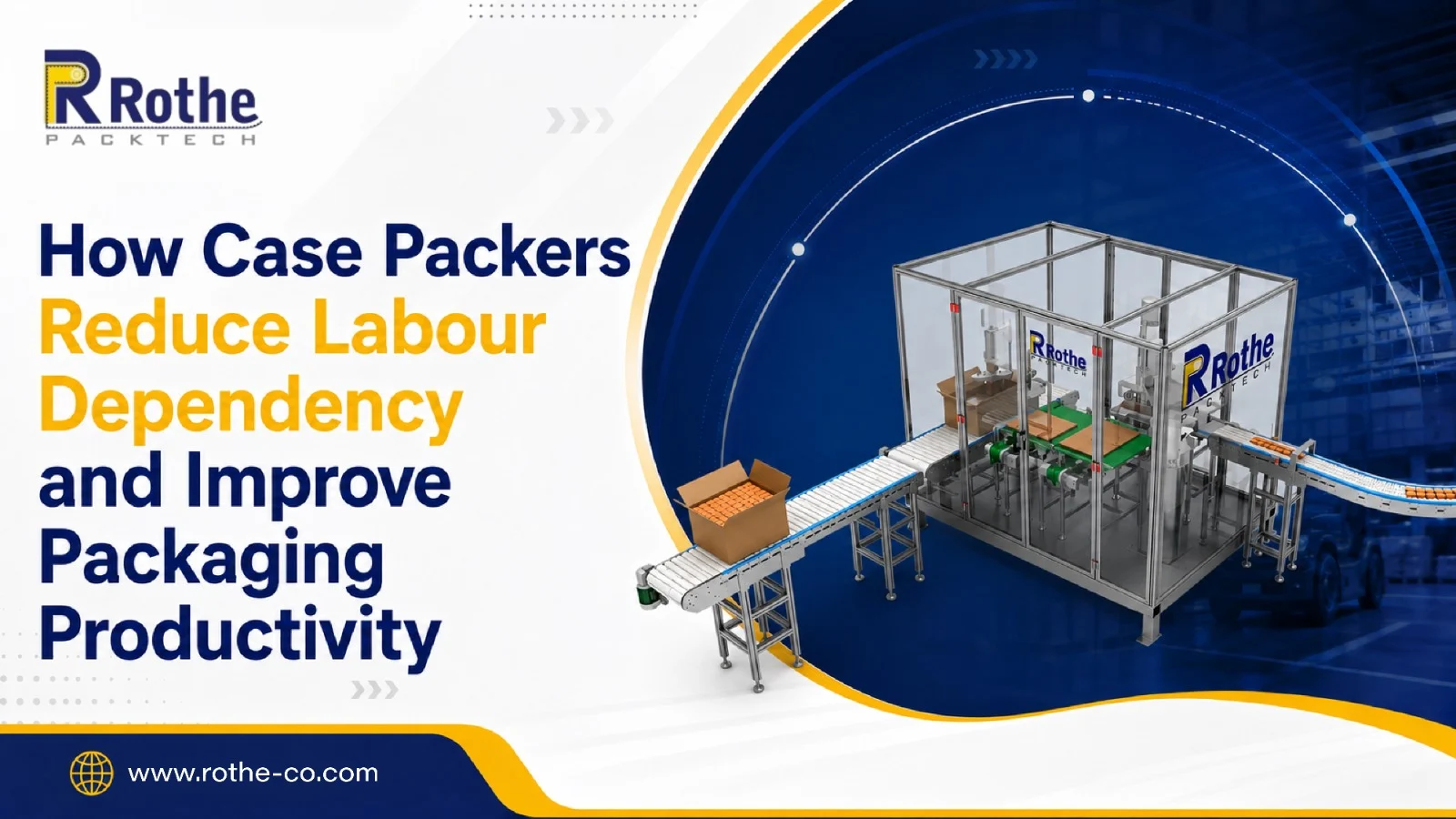
Packaging is a critical stage of manufacturing, but repetitive manual packing can quickly become a bottleneck as production volumes increase.
Manually picking products, arranging them into cartons, loading cases, and preparing them for the next stage requires continuous operator involvement. Over multiple shifts, this can increase labour dependency, create productivity challenges, and introduce inconsistencies in the packing process.
A case packer provides an automated alternative.
By automating the process of placing products into cartons or cases, manufacturers can improve packaging productivity while reducing repetitive manual handling and creating a more consistent end-of-line operation.
What Is a Case Packer?
A case packer is an automated packaging machine designed to place individual products, containers, packs, or bundles into cartons or cases according to a predefined configuration.
Depending on the product and packaging requirement, a case packing system can automate activities such as:
- Product collation
- Product grouping
- Carton preparation
- Product loading
- Case closing
- Case transfer
- Packaging line integration
Case packers can be designed for different product types, packaging formats, production speeds, and plant layouts.
When integrated with conveyors and downstream automation, they can become an important part of a complete end-of-line packaging automation system.
Why Are Manufacturers Automating Case Packing?
As manufacturing operations become more competitive, companies are under increasing pressure to produce more while maintaining quality and controlling operating costs.
Manual case packing can create several challenges.
High Labour Dependency
Manual packing requires operators to continuously pick, arrange, and place products into cartons.
When production volumes increase, maintaining the required output may require additional operators or multiple shifts.
A case packer automates repetitive packing activities, reducing the amount of manual intervention required.
Packaging Bottlenecks
A high-speed production line is only as efficient as its slowest stage.
If products are manufactured quickly but case packing is performed manually, the packing operation can become a bottleneck.
Automated case packing helps synchronize product flow with production requirements.
Inconsistent Packing
Manual packing can result in differences in product positioning, carton loading, and packing patterns.
A case packer follows a programmed packing sequence, helping achieve repeatable results throughout production.
Operator Fatigue
Repetitive packing operations can become physically demanding over long shifts.
Automating these activities allows operators to move away from continuous repetitive handling and focus on supervision, quality, and other production responsibilities.
Key Benefits of a Case Packer
1. Reduce Repetitive Manual Labour
One of the primary benefits of case packing automation is reducing the amount of repetitive manual work required on the production floor.
Instead of having operators continuously load individual products into cartons, the machine performs the repetitive packing cycle automatically.
This can help manufacturers optimize manpower allocation without compromising production requirements.
2. Improve Packaging Productivity
A case packer can provide a consistent and controlled packing cycle.
This is particularly beneficial for manufacturers operating medium- and high-volume production lines where packaging speed needs to match upstream production.
By removing manual delays between product handling and carton loading, manufacturers can improve overall packaging flow.
3. Achieve Consistent Packing Patterns
Product arrangement inside a case is important for packaging quality, transportation, and storage.
Automated case packers can be programmed to follow specific packing configurations.
This provides greater consistency across production batches and reduces variation caused by manual handling.
4. Improve Product Handling
Automated movement and controlled product placement can reduce unnecessary handling.
Depending on the product and machine configuration, the system can carefully collect, group, position, and load products into cases.
This can help reduce handling-related product damage.
5. Support Multiple SKUs
Many modern manufacturers handle multiple product sizes and packaging configurations.
A properly designed case packing solution can support different SKUs and packing patterns, subject to the machine’s configuration and changeover requirements.
This makes automation suitable for manufacturers looking for greater flexibility as their product portfolio expands.
6. Improve End-of-Line Efficiency
Case packing does not have to operate as an isolated process.
It can be integrated with:
- Product conveyors
- Case erectors
- Case sealers
- Robotic pick-and-place systems
- Robotic palletizers
- Inspection systems
- Material handling systems
Case Packer vs Manual Case Packing
Factor | Manual Case Packing | Automated Case Packer |
Labour dependency | High | Reduced |
Repetitive handling | Manual | Automated |
Packing consistency | Operator dependent | Programmed and repeatable |
Production speed | Variable | Consistent |
Operator fatigue | Higher | Lower |
Scalability | Requires additional manpower | Supports production expansion |
Integration | Limited | Can integrate with end-of-line systems |
Process control | Manual | Automated |
The right choice depends on production volume, product type, packaging format, available space, and investment objectives.
Where Can Case Packers Be Used?
Case packing automation can be applied across a wide range of manufacturing and packaging environments.
Potential applications include:
- Food and beverage
- FMCG
- Pharmaceutical
- Consumer products
- Chemical products
- Industrial products
- Bottles and containers
- Pouches and packaged goods
- Cartonized products
The machine configuration should be selected according to product dimensions, weight, packaging format, production speed, and required case configuration.
Why Invest in Case Packing Automation?
The business case for a case packer should be evaluated across the complete production process.
Manufacturers can look beyond the initial machine investment and consider the potential impact on:
Labour → Productivity → Consistency → Product Handling → Throughput → Scalability
For high-volume production environments, reducing repetitive manual operations can provide significant operational value over the life of the equipment.
The objective is not simply to automate one task.
It is to create a faster, more consistent, and more scalable packaging operation.
Case Packers From Rothe Packtech
At Rothe Packtech, case packing is part of a broader approach to packaging and end-of-line automation.
The right case packing solution can be engineered around the manufacturer’s specific product, production rate, case configuration, SKU requirements, and factory layout.
Rothe Packtech’s automation capabilities can include case packing, conveyor integration, robotic pick-and-place, robotic palletizing, and complete end-of-line automation solutions.
This enables manufacturers to move beyond standalone equipment and develop an integrated packaging workflow.
Ready to Improve Your Production Efficiency?
Talk to Rothe Packtech’s automation experts to discuss your production line and explore the right end-of-line packaging automation solution for your application.