
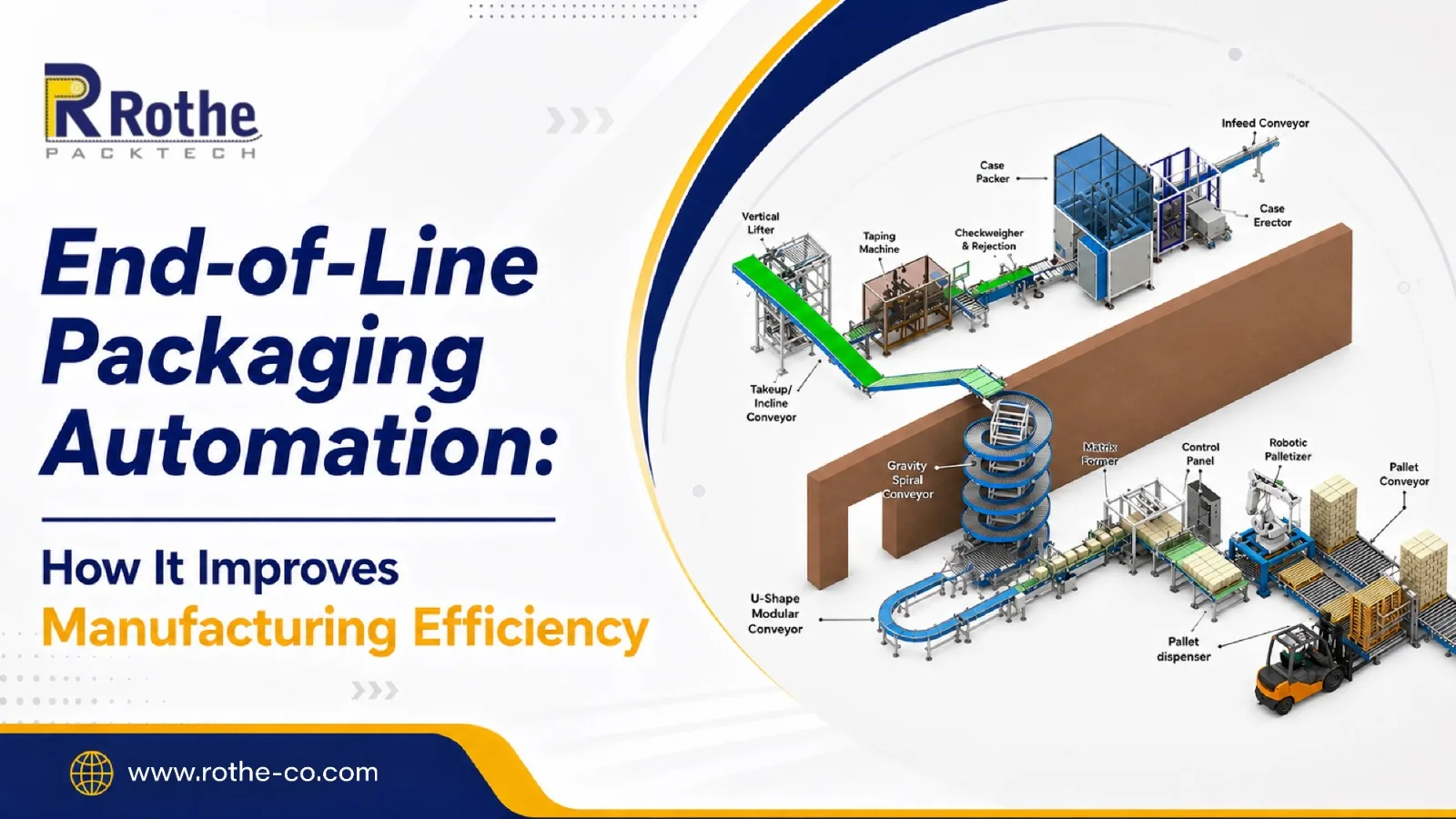
In modern manufacturing, improving production speed is only one part of achieving operational efficiency. What happens after a product is manufactured is equally important. Packaging, case handling, palletizing, conveying, and dispatch preparation can become major bottlenecks when these processes depend heavily on manual labour.
This is where end-of-line packaging automation plays an important role.
By integrating automated case packing, robotic pick-and-place systems, conveyors, palletizers, and other packaging equipment, manufacturers can streamline their final production stages and create a more reliable flow from finished product to dispatch.
For manufacturers looking to increase productivity while reducing manpower dependency and operational costs, end-of-line automation can provide a scalable solution.
What Is End-of-Line Packaging Automation?
End-of-line packaging automation refers to the use of automated machinery and integrated systems to manage the final stages of a manufacturing and packaging process.
Depending on the application, an automated end-of-line system can include:
- Case packing
- Carton handling
- Product collation
- Conveyor systems
- Robotic pick-and-place
- Robotic palletizing
- Material handling
- Pallet handling
- Packaging line integration
- Automated dispatch preparation
Why Are Manufacturers Moving Toward End-of-Line Automation?
Manufacturing companies are facing increasing pressure to produce more while maintaining consistent quality and controlling operating costs.
Several common challenges can make manual end-of-line operations inefficient:
1. High Manpower Dependency
Manual packing, carton handling, and palletizing require continuous operator involvement. As production volumes increase, manufacturers may need additional manpower to maintain output.
Automation reduces repetitive manual handling and allows employees to focus on higher-value activities.
2. Production Bottlenecks
A high-speed production line can lose its efficiency if packaging and palletizing cannot keep pace.
End-of-line automation helps synchronize packaging and material movement with production output, reducing bottlenecks between manufacturing and dispatch.
3. Inconsistent Packaging Quality
Manual operations can lead to variations in carton placement, packing patterns, pallet stacking, and product handling.
Automated systems provide repeatable movements and controlled processes, helping manufacturers maintain consistent packaging quality.
4. Rising Operational Costs
Labour, product damage, downtime, and inefficient material movement can increase the cost of every production cycle.
Automation can help manufacturers optimize these processes and improve overall operational efficiency.
5. Workplace Safety
Repetitive lifting and movement of cartons, bags, containers, and other products can place physical demands on operators.
Automated conveyors, robotic systems, and palletizers can reduce unnecessary manual handling and improve workplace safety.
Key Benefits of End-of-Line Packaging Automation
Increased Production Throughput
Automated systems can operate continuously at a controlled and repeatable speed. This allows manufacturers to handle higher production volumes without increasing manual intervention at the same rate.
For production environments where packaging is a constraint, improving end-of-line capacity can have a direct impact on overall throughput.
Reduced Manual Handling
Automation reduces repetitive activities such as lifting, carrying, packing, transferring, and palletizing.
This can reduce manpower dependency while allowing existing employees to concentrate on supervision, quality control, machine operation, and other important tasks.
Improved Packaging Consistency
Automated case packers and robotic systems follow programmed movements and predefined patterns.
This creates more consistent packing and palletizing results, which can improve product presentation and reduce handling-related issues.
Lower Product Damage
Improper manual handling can sometimes result in damaged cartons or products.
Automated systems can provide controlled movement throughout the packaging process, helping minimize unnecessary product handling and damage.
Better Space Utilization
A properly engineered automation system can be designed around the existing plant layout.
Conveyor integration, robotic cells, and automated packaging equipment can be positioned to optimize product flow and make better use of available floor space.
Improved Dispatch Readiness
When packing, conveying, and palletizing are integrated, products can move more efficiently toward the dispatch area.
This helps manufacturers create a smoother transition between production, packaging, storage, and transportation.
Major Components of an Automated End-of-Line System
A complete end-of-line packaging system may combine several technologies depending on the application.
Case Packers
Case packers automatically place products into cartons or cases according to the required packaging configuration.
They are particularly useful for manufacturers handling repetitive packaging operations at medium or high production speeds.
Robotic Pick-and-Place Systems
Robotic pick-and-place systems can automatically collect and position products according to a predefined pattern.
With suitable end-of-arm tooling, robotic systems can be customized for different product shapes, sizes, and handling requirements.
Robotic Palletizers
Robotic palletizers automate the stacking of cases, bags, cartons, or other packaged products onto pallets.
They can provide consistent pallet patterns and reduce the physical workload associated with manual palletizing.
Conveyor Integration
Conveyors connect different stages of the packaging process.
They can be used for accumulation, product transfer, merging, diverting, elevation, and movement between packaging and palletizing cells.
Complete End-of-Line Automation
For manufacturers seeking a comprehensive solution, multiple machines can be integrated into a single automated line.
A typical workflow could include:
Product → Case Packing → Conveyor Transfer → Palletizing → Pallet Handling → Dispatch
This integrated approach can provide a single coordinated system rather than multiple independent machines.
How End-of-Line Automation Improves Manufacturing Efficiency
The real value of automation comes from integrating individual processes into an efficient production flow.
For example, consider a manufacturing plant where cartons are manually collected from the packaging machine and transported to a palletizing area. Operators then manually arrange the cartons on pallets before moving completed pallets toward dispatch.
This creates multiple opportunities for delays, inconsistent stacking, manual handling, and production bottlenecks.
With an integrated automated system, cartons can be packed, conveyed, positioned, palletized, and prepared for dispatch with significantly less manual intervention.
This improves process consistency, throughput, material flow, and operational control.
Choosing the Right End-of-Line Automation Solution
Automation should not be treated as a one-size-fits-all investment.
The right system depends on several factors, including:
- Product type and dimensions
- Packaging format
- Carton or bag specifications
- Production speed
- Required output
- Pallet configuration
- Available floor space
- Number of SKUs
- Product changeover requirements
- Existing machinery
- Future production expansion
A detailed assessment of the production line and plant layout helps determine the appropriate automation architecture.
Simulation and line planning can also help identify potential bottlenecks before equipment is manufactured and installed.
Why Customized Automation Matters
Every manufacturing plant has different products, processes, layouts, and production requirements.
A customized end-of-line automation system can be engineered around the manufacturer’s specific operating conditions rather than forcing the production process to adapt to a standard machine.
This approach can include:
- Custom machine engineering
- Line layout planning
- Conveyor integration
- Robotic integration
- Safety systems
- Changeover engineering
- Installation and commissioning
- Documentation and validation
- Preventive maintenance support
A complete project approach can also provide a single point of responsibility from concept and engineering through installation and commissioning.
Industries That Can Benefit From End-of-Line Automation
End-of-line packaging automation can be applied across a wide range of manufacturing environments, including:
- Food processing
- Beverage
- FMCG
- Pharmaceutical
- Consumer goods
- Chemical
- Industrial manufacturing
- Distilleries and breweries
The automation configuration can be adapted according to the product, packaging requirements, production volume, and operating environment.
The Future of Manufacturing Is More Connected
As manufacturers continue to focus on productivity, cost optimization, workplace safety, and scalability, automation is becoming an increasingly important part of production strategy.
End-of-line operations should not be viewed as an isolated packaging activity. They are an important part of the overall manufacturing flow.
Connecting case packing, conveyors, robotic handling, palletizing, and dispatch preparation can help manufacturers build a more efficient and scalable production environment.
Automate Your End-of-Line Operations With Rothe Packtech
At Rothe Packtech, end-of-line automation solutions are engineered around the specific requirements of modern manufacturing environments.
The company’s solution ecosystem includes case packers, robotic pick-and-place systems, conveyor integration, robotic palletizers, and complete end-of-line automation solutions.
Rothe Packtech focuses on custom engineering, line planning, system integration, safety integration, installation, commissioning, documentation, and after-sales support to help manufacturers move from production to dispatch more efficiently.
Whether the requirement is to reduce manual handling, improve throughput, increase packaging consistency, or create a complete automated packaging line, a properly engineered solution can help transform end-of-line operations.
Ready to Improve Your Production Efficiency?
Talk to Rothe Packtech’s automation experts to discuss your production line and explore the right end-of-line packaging automation solution for your application.